Friday, November 30, 2012

TCR Story of the Month for November: An Intrusion by Tim Wirkus

Tim Wirkus
The Committee Room is proud to present "An Intrusion" by Tim Wirkus as TCR Story of the Month for November. In this brief, intense, and precisely rendered story a young couple find their marriage unraveling after discovering mysterious photographs.


Tim Wirkus's short fiction has appeared in Gargoyle, Cream City Review, Sou’wester and Ruminate Magazine. He has been nominated for a Pushcart Prize, been recognized on the list of Other Distinguished Stories in Best American Mystery Stories 2011, and been selected as a finalist in Narrative’s 30 Below contest. He’s currently pursuing a PhD in creative writing and literature at the University of Southern California.

Monday, November 26, 2012

Reading and Writing of U.S. Presidents

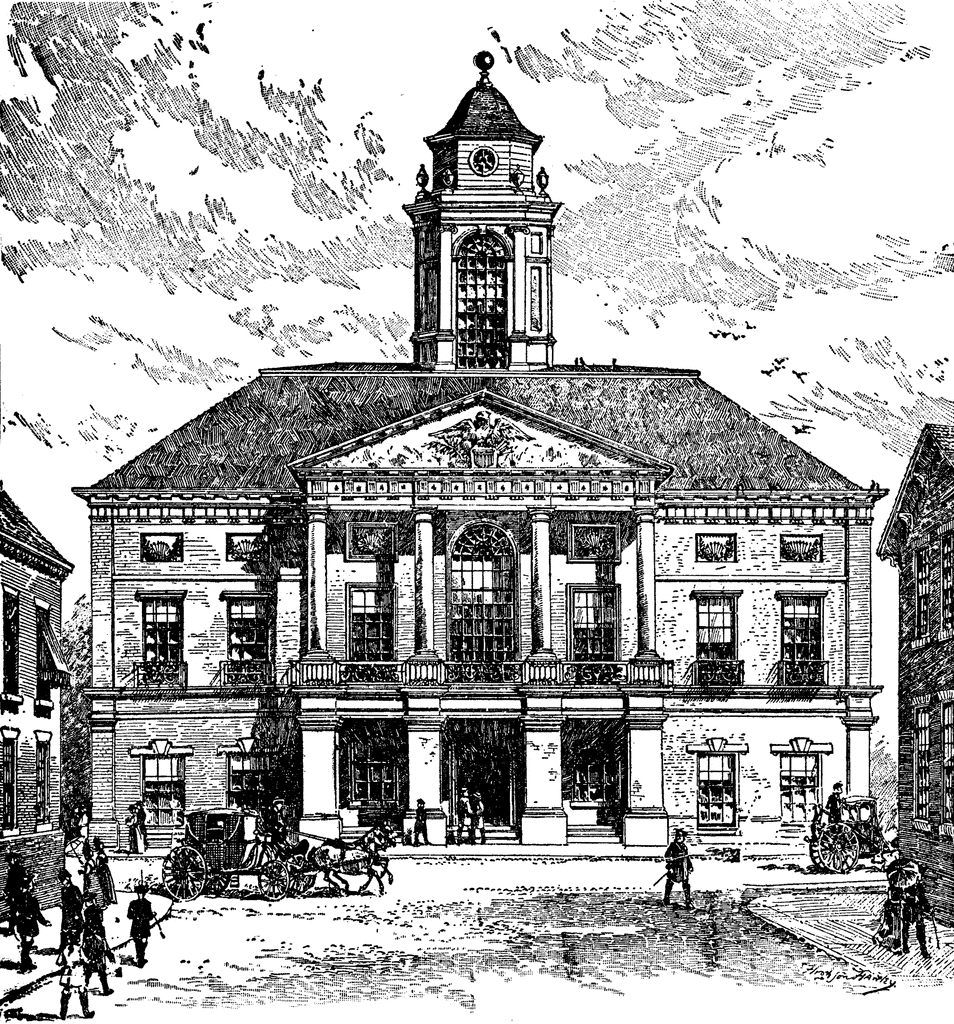
Federal Hall, New York
The Committee Room marks the recent presidential election by taking a look at the reading and writing done by a few of the American Presidents.

In 1789, when the U.S. capital was New York City, President George Washington, famed for never telling a lie, borrowed a volume of transcriptions of British House of Commons debate and The Law of Nations by Swiss philosopher and legal scholar Emerich de Vattel from the New York Society Library. He never returned them. The library and the national government were both housed in Federal Hall in Lower Manhattan. Washington's overdue books became known to the library in the 1930s when a detailed "charging ledger" covering 1789 to 1792 was discovered in a trash pile in the library's basement.

In more recent years a conservation project on the ledger brought the missing books to the attention of the New York Daily News which published a brief article on Washington's debt to the library. In 2010, the Mount Vernon Estate and Gardens, which could not locate the borrowed books in its own collection, settled Washington's account at least in part by purchasing a copy of the same edition of The Law of Nations for $12,000 and giving it to the Society Library.
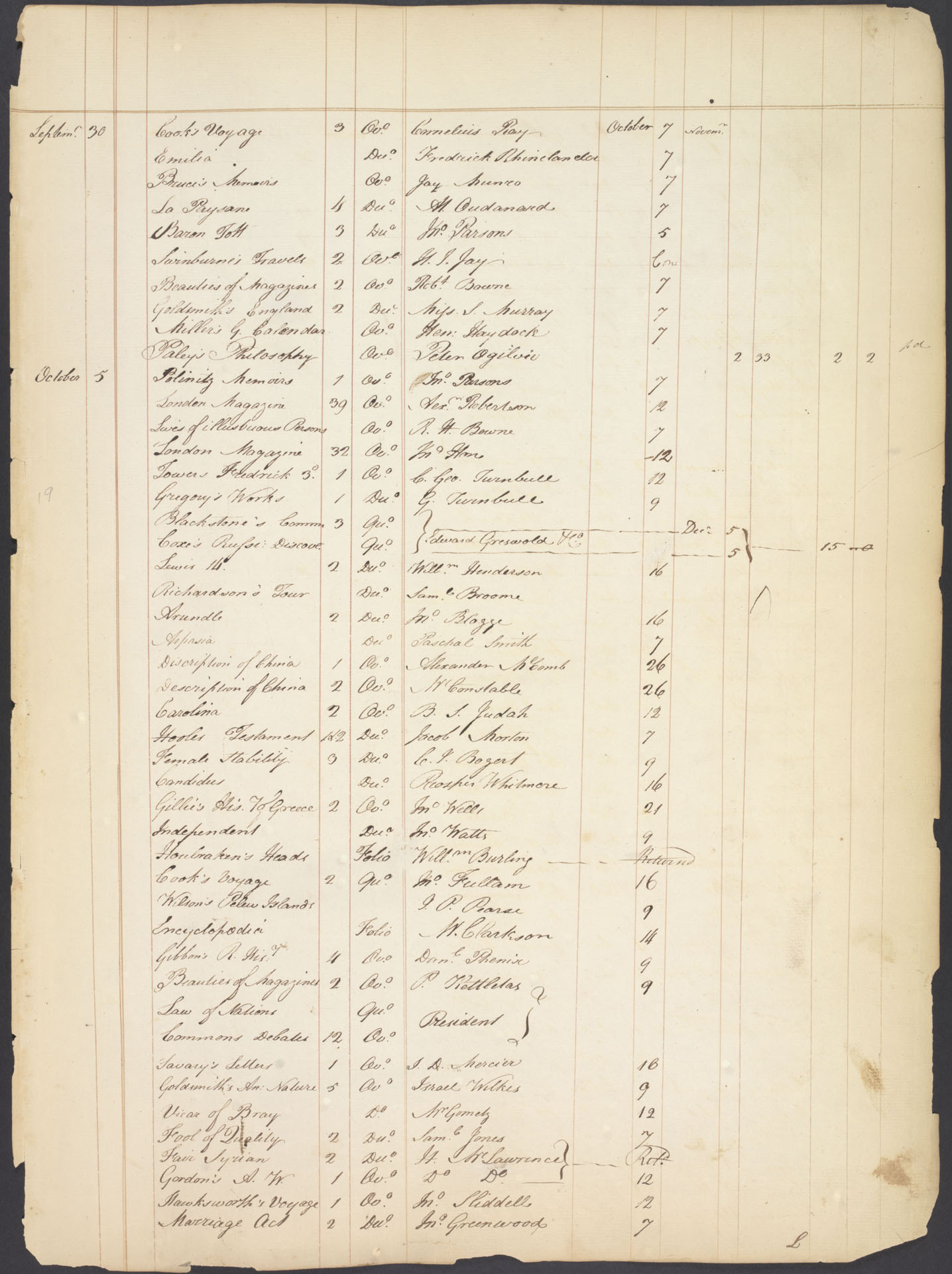
Charging Ledger (New York Society Library)
George Washington wrote between 18,000 to 20,000 letters but no books. He is sometimes credited with writing Rules of Civility, excerpts of which he copied into his notebooks as a youth. According to scholars at the Papers of George Washington, Rules of Civility was probably composed in the late sixteenth century by Jesuits in France and the young Washington copied from a seventeenth century English translation.

John Adams, serving as Washington's Vice President, borrowed a volume of Elements of Criticism by Scottish Enlightenment philosopher and jurist Lord Kames from the New York Society Library. Adams returned it  Despite having the Society Library's collection available to him Adams in 1789 wrote to his wife Abigail in Massachusetts to send him items by Hume, Johnson, Priestley, Livy, Tacitus, Cicero and Plutarch from his personal library. Adams knew Latin and Greek believed that knowledge of the classics was and should remain the mark of a learned man. He especially liked Cicero's essay on growing old, De Senectute, and turned to it throughout his life. Apart from the classics, Adams' favorites were Shakespeare, Swift, and Cervantes. "On board all day, reading Don Quixote," is the entry in Adams' diary for May 18, 1779 while he waited in Nantes, France to sail back to America.

Friday, November 16, 2012

Update on TCR Story of the Month Author Edward McWhinney

Edward McWhinney
Edward McWhinney, the talented Irish writer whose story "To Ipswich" was TCR Story of the Month for June, has three new stories published --

"On a Barge," a brief and searing portrait of man in an existential crisis, in Contrary (Summer 2012)

"After Mass," a work of creative non-fiction exploring an individual's place in the scheme of things, in Word Riot (August 2012)

"Adrift in the Ghetto," a mesmerizing tale of a stranger trying to find his bearings in an alien city, in Juked (8 November 2012)

TCR Story of the Month series locates and links to some of the best new fiction published online.

The Committee Room.  Interesting Articles for Interested Readers.  Since 2011.

Wednesday, October 31, 2012

TCR Story of the Month (Classic) for October: Paul's Case by Willa Cather

Willa Cather, 1905 (courtesy of U. of Nebraska)
The Committee Room departs from its presentation of the best in contemporary fiction to offer a classic story, Willa Cather's "Paul's Case," as TCR Story of the Month for October.

"Paul's Case" has been called "a small masterpiece of sustained tone" and a story "justly admired for its narrative skill and its psychological portraiture."

The story of an opera and theater loving Pittsburgh youth who makes a desperate escape from the reality of his ordinary lower middle class life, "Paul's Case" was the seventh and last story in Cather's first collection of stories, The Troll Garden, published in 1905. All of the stories in The Troll Garden deal with art and artists. Soon after the collection's publication, "Paul's Case" reached a wider audience when it was reprinted in McClure's Magazine, a leading general interest magazine.

Tuesday, October 30, 2012

Writers on Time Magazine Covers

Joseph Conrad, 1923
The Committee Room looks at how literature has been treated by the mainstream American media as we take an accounting of the literary figures deemed notable enough for Time to put them on its cover.

Time was founded by two young Yale graduates -- bon vivant Briton Hadden and sober-minded Henry Luce -- with the aim of keeping the "busy man" well informed. Its first issue appeared on March 3, 1923. On the cover was elderly former Speaker of the House Joseph Cannon, an Illinois Republican who was retiring from his Congressional seat after a record breaking number of years in office.

Time's first author cover came early on. The cover of its sixth issue, published on April 7, 1923, offered a sketch portrait of Joseph Conrad. The accompanying article -- a few paragraphs about Conrad making his first visit to the United States -- was without a byline since all Time articles were supposed to be a collaborative effort of the staff, a practice the magazine continued for many decades.

Thursday, October 18, 2012

TCR Spotlight on Theater: Wendy Wasserstein

The Committee Room recently spoke with Julie Salamon whose widely praised biography of the late playwright Wendy Wasserstein -- Wendy and the Lost Boys: The Uncommon Life of Wendy Wasserstein -- was just released in paperback. Salamon is a journalist who has worked for the Wall Street Journal and New York Times. Her 1992 book The Devil's Candy, an examination of the making of the screen version of Tom Wolfe's novel The Bonfire of the Vanities, is a classic look at behind the scenes Hollywood.

Salamon came to the Wasserstein biography at the suggestion of her editor at Penguin who had been approached by a close friend of Wasserstein, Andre Bishop, artistic director of Lincoln Center Theater. Bishop serves as literary executor for Wasserstein's work including her best known play The Heidi Chronicles which won both the Tony Award for best play and the Pulitzer Prize for drama in 1989. Bishop realized that a biography of Wasserstein, who died in 2006, was inevitable and wanted the project done properly.

Wednesday, September 26, 2012

TCR Story of the Month for September: How to Adopt a Cat by Dave K.

Dave K. 
The Committee Room is pleased to present "How to Adopt a Cat" by Dave K. as TCR Story of the Month for September.

Set in a steampunk world, "How to Adopt a Cat" follows a friendless man on his release from an insane asylum. With superbly rendered detail, this intense, offbeat story delves into the mind of a desperate character on the margins of life.

Dave K. is a writer and artist who lives in Baltimore. His work has been published in Front Porch Journal, Battered Suitcase, LOOP, Artichoke Haircut, and Welter, and he self-publishes through Banners of Death Press. A collection of his stories is Stone a Pig (2012). When he’s not writing, Dave K. is a valley on the southern side of Windwhistle Peak, in the Allan Hills.