Teach the kids Shakespeare. Put that on the "to do" list just after creating world peace, discovering a cure for cancer, and composing a grand opera. Teach the kids Shakespeare? It's just not gonna happen. Playwright Ken Ludwig disagrees. In his book How to Teach Your Children Shakespeare, Ludwig explains why giving your kids knowledge of the Bard's work is an important goal and a realistically achievable one.
Ludwig is a highly successful writer for the theater. His precision-timed farces Lend Me a Tenor and Moon Over Buffalo enjoyed long-runs on Broadway and in London. He wrote the libretto to Crazy for You, a musical built around the songs of George Gershwin, which was also a hit on both sides of the Atlantic. Before making his mark in the theater, Ludwig, a man of many interests, practiced law in Washington, DC for several years and still retains an "of counsel" position with the firm of Steptoe and Johnson.
Shakespeare and the King James translation of the Bible are, in Ludwig's view, the two "bedrocks" of modern civilization in the English-speaking world. "For more than five thousand years Moses, Jesus, and other towering figures of the Old and New Testaments were the archetypes of our consciousness. In modern society Hamlet and Macbeth, Juliet and Ophelia, have been added to their number," Ludwig writes in the early pages of the book, which was recently published by Crown, a division of Random House.
Friday, November 1, 2013
Tuesday, October 22, 2013
TCR Story of the Month for October: "Blue Cotton" by Lindsey Thordarson
![]() |
| Lindsey Thordarson |
An absorbing, novelistic story exploring the rough lives and strong emotions of textile workers in nineteenth century New England, "Blue Cotton" takes readers on a journey to another time and place and, perhaps most importantly, into the complex mind of its troubled protagonist.
Lindsey Thordarson received her MFA from St. Mary’s College of California. Her work has appeared in many print and online journals, including ZYZZYVA and California Northern Magazine, and received the 2010 Doug Fir Fiction Award. She lives in Petaluma, California.
Sunday, October 13, 2013
OK, What's the World's Best Known Word? Okay,That May Be It.
In observance of Columbus Day, The Committee Room asks you to consider how often you say OK. This little Americanism is probably the world's most used word. In OK: The Improbable Story of America's Greatest Word Allan Metcalf writes "[T]hese two simple letters (or four, if you use its genteel alter ego okay) anchor our agreements, confirm our understandings, and choreograph the dance of everyday life...OK is the most amazing invention in the history of American English."
Among English speakers, at least, OK's versatility is astounding. It is put to work an adjective ("The council deemed the project OK"), a noun ("The council gave its OK to the project"), a verb ("The council OK'd the project"), occasionally as an adverb ("The council took the criticism OK"), and most frequently as a throat clearing interjection ("The council member began the discussion with 'OK, let's talk about the project'"). Depending upon tone and context OK can convey a positive or neutral assessment. Partnered with a minimizer as such "just" or "only" or "merely" it becomes negative.
Thursday, September 26, 2013
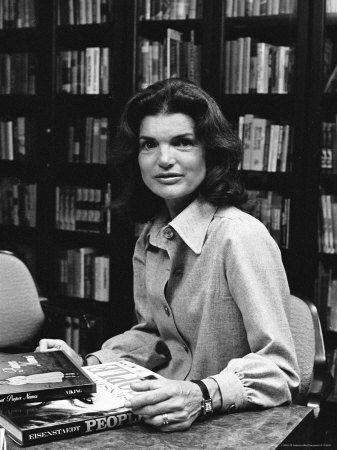
Jacqueline Kennedy Onassis' Career in Publishing
| Jackie at work. |
The former First Lady spent nearly twenty years as an editor, a period longer than that of her celebrated marriages to JFK and Aristotle Onassis combined. First at Viking, then at Doubleday, Jackie helped shepherd to publication nearly one hundred books, both fiction and non-fiction.
The death of Greek shipping magnate Onassis in the spring of 1975
left Jackie, at age forty-five, a widow for the second time.
Her children were teenagers requiring less of her attention. The most famous woman in the world found herself at something of a loose end.
Tuesday, September 17, 2013
TCR Story of the Month for September: "Senator Max Baucus Leaves Five Tips" by Kelly Ramsey
![]() |
| Author Kelly Ramsey |
A highly original work of fiction using real life characters and skillfully manipulated visuals, "Senator Max Baucus Leaves Five Tips" grabs the attention with its brief but incisive look at politics, power, and personal relationships.
Kelly Ramsey's prose has appeared or is forthcoming in American Short Fiction, Orion, and The Material. This October she will be a fellow at the MacDowell Colony.
Tuesday, September 10, 2013
TCR Literary Journals Series: A Brief Interview with Linda Swanson-Davies of Glimmer Train
![]() |
| Issue 88, Fall 2013 |
The journal's title comes from the sisters having had no plans to start a literary journal but could in retrospect see that glimmers of the idea had gone through their minds. Now that the idea had fully emerged they were going forward with it like a locomotive speeding down the rails.
Glimmer Train is published three times a year in carefully put together print issues, including a Spring/Summer double issue. Swanson-Davies and Burmeister-Brown strongly believe that a handsome physical publication reflects the enduring quality of its contents. They are also committed to paying the writers whose work appears in Glimmer Train. Over $50,000, funded by contest fees and subscriptions, goes to writers each year.
Tuesday, September 3, 2013
The 200 Best Novels in English Since 1950
What were the best English language novels written in the second half of the twentieth century? Writer Colm Toibin and editor/publisher Carmen Callil tackle this question in The Modern Library: A Brief Guide to the 200 Best Novels in English Since 1950.
"Enthusiasm is the driving force of this book. Its purpose is to celebrate the writers we have loved best, and to proselytize on behalf of their novels," Toibin and Callil write in the introduction.
Toibin and Callil delineate three types of novels written since 1950 -- "massively ambitious and complex" works such as William Gaddis' The Recognitions (1955) and Angela Carter's Wise Children (1991) that "take their bearings" from the early twentieth century Modernist giants James Joyce and Virginia Woolf and leave characters, dialogue, and plot "open to question;" traditional style novels, such as Anita Brookner's Friends and Family (1985) and Patrick Hamilton's The West Pier (1951), that follow a "system in which things are slowly revealed and objects in the landscape are described in some detail;" and a modernist/traditional combination, the most common style in the later twentieth century, that takes in lessons from Joyce and Woolf about language, form, voice, and tone without abandoning completely traditional narrative methods.
"Enthusiasm is the driving force of this book. Its purpose is to celebrate the writers we have loved best, and to proselytize on behalf of their novels," Toibin and Callil write in the introduction.
Toibin and Callil delineate three types of novels written since 1950 -- "massively ambitious and complex" works such as William Gaddis' The Recognitions (1955) and Angela Carter's Wise Children (1991) that "take their bearings" from the early twentieth century Modernist giants James Joyce and Virginia Woolf and leave characters, dialogue, and plot "open to question;" traditional style novels, such as Anita Brookner's Friends and Family (1985) and Patrick Hamilton's The West Pier (1951), that follow a "system in which things are slowly revealed and objects in the landscape are described in some detail;" and a modernist/traditional combination, the most common style in the later twentieth century, that takes in lessons from Joyce and Woolf about language, form, voice, and tone without abandoning completely traditional narrative methods.
Subscribe to:
Posts (Atom)