Master the use of these phrases and begin your career as a pundit --
I would argue
That said
Moving forward
Quite frankly
Game changer
At the end of the day
Crunch time
Wake up call
Red flags
Get it right
To put it another way -- "Quite frankly, I would argue, this is a wake up call. The red flags were ignored. It's crunch time. That said, moving forward, this will be a game changer and at the end of the day, we've got to get it right."

Monday, March 19, 2012


Wednesday, March 14, 2012
TCR Story of the Month for March: "Paradise" by Jean Ryan
The Committee Room is thrilled to offer Jean Ryan's "Paradise" as its Story of the Month for March. A brightly told tale of a woman making a new life in Palm Springs after a failed romance in Vermont, "Paradise" is an emotionally truthful and often laugh out loud funny look at human (and animal -- love that parrot!) nature.
Jean Ryan, a native Vermonter, lives in Napa, California. Her stories and essays have appeared in a variety of journals, including Other Voices, Pleiades, The Summerset Review, The Massachusetts Review and Blue Lake Review. She has also published a novel, Lost Sister (2005). A collection of her short stories will be published by Ashland Creek Press in 2013.
"Paradise" was published by Blue Lake Review (November 2011) and previously appeared in The Massachusetts Review.
To read "Paradise" click here
TCR Story of the Month highlights an outstanding work of fiction published online in the preceding twelve months.
TCR Chats with Jean Ryan
 Q: How long have you been writing?
Jean Ryan, a native Vermonter, lives in Napa, California. Her stories and essays have appeared in a variety of journals, including Other Voices, Pleiades, The Summerset Review, The Massachusetts Review and Blue Lake Review. She has also published a novel, Lost Sister (2005). A collection of her short stories will be published by Ashland Creek Press in 2013.
"Paradise" was published by Blue Lake Review (November 2011) and previously appeared in The Massachusetts Review.
To read "Paradise" click here
TCR Story of the Month highlights an outstanding work of fiction published online in the preceding twelve months.
TCR Chats with Jean Ryan

A: Since I was a child. I’ve had dry periods that lasted more than a year, but inevitably I am pulled back. Translating ideas and experience into words is how I make sense of the world. Finding the right phrasing is a tremendous challenge—like tuning a musical instrument, perhaps: one just knows when the right chord has been struck. This intuitive knack may be the one thing that can’t be taught in writing classes. Humor, another element I strive for, is also challenging. Like other aspects of composition, it is best approached from the side. Jean Thompson does humor very well.
Q: What was the inspiration for “Paradise”?
A: I had watched a program about intelligence in birds, parrots in particular. One bird had acquired a prodigious vocabulary and this stirred my imagination. I thought it would be fun to work this creature into a story, to use him in fact as a main character. In order to create conflict, the parrot in this tale is malicious as well as brilliant. The extravagance of Palm Springs, its artificial overlay, seemed an apt parallel to the various indulgences that Max enjoyed in his man-made abode.
Q: Who are some of your favorite contemporary writers?
A: I love the immediacy and brevity of short stories and some of my favorite contemporary authors are masters of this form. Among many others, I admire the work of Lorrie Moore, Helen Simpson, Amy Bloom, Antonya Nelson, Jean Thompson, James Lasdun, Marisa Silver, Annie Proulx, Rick Bass and Joy Williams. Russell Hoban’s Turtle Diary is one of my favorite novels, along with J. L. Carr’s A Month in the Country and Rhine Maidens by Carolyn See. In the genre of poetry, I am in constant awe of Mary Oliver.
Q: Favorite classic authors?
A: Virginia Woolf of course. And Anton Chekov. Graham Greene is wonderful, along with George Orwell, J.D. Salinger, John Steinbeck, Harper Lee and E.M. Forster. I also admire Paul Bowles and the eerie suspense he was able to create. My favorite Hemingway work would have to be A Moveable Feast. F. Scott Fitzgerald’s The Great Gatsby is an exquisite novel.
Monday, March 12, 2012
Hear Authors Read Their Work on The Writers' Block Podcasts

Monday, February 20, 2012
TCR Literary Journal Series: Blue Lake Review

Blue Lake Review was founded in 2010 by Mitchell Waldman and Diana May-Waldman. Mitchell Waldman is a widely published fiction writer whose work includes the short story collection Petty Offenses and Crimes of the Heart (Wind Publications, 2011) and the novel A Face in the Moon (Writers Club Press, 2000). May-Waldman is a poet, essayist, and award-winning journalist. Her work includes the poetry volume A Woman's Song (Publish America, 2009). She is an editor at the independent news website Worldwide Hippies. Waldman and May-Waldman co-edited Wounds of War: Poets for Peace (Publish America, 2006) and Hip Poetry 2012 (Wind Publications, forthcoming).
Waldman and May-Waldman recently spoke with The Committee Room.
An Interview with the Editors of Blue Lake Review
Q: Why did you want to start a literary journal when there are already so many?
A: As writers ourselves we started Blue Lake Review to help discover new writers and bring more exposure to good writers both known and unknown.
Q: Why did you call it Blue Lake Review?
A: We live on Lake Ontario and love the water.
 |
| Diana May-Waldman |
A: We've gotten a lot of following from our Facebook page. We've also received notice from our listing at the Poets and Writers site, other literary review listing sites, Duotrope, other literary journals linking to us, as well as by word of mouth of our contributors and readers.
Q: How many submissions does Blue Lake Review receive in a typical month?
A: We get anywhere from sixty to one-hundred submissions per month.
"Authentic writing is believable, moving, whether based on autobiographical experiences or not. Authentic writing is real or very easily could be. It comes from the writer's heart."
Q: In the guidelines you state that Blue Lake Review is looking for both fiction and poetry that is "authentic." Could you elaborate on that?
A: We are looking for writing that is original, not contrived, not trying to copy the style of other writers. Authentic writing is believable, moving, whether based on autobiographical experiences or not. Authentic writing is real or very easily could be. It comes from the writer's heart.
Q: What happens when a submission is received?
A: We try to read the manuscripts as soon as we can, in the order received. Diana reads poetry submissions. Mitchell reads fiction and essay submissions. Promising submissions are either accepted or held for possible consideration for publication.
Q: How many submissions (fiction, poetry, essays) are rejected after one reading?
A: The majority of submissions are rejected after one reading. Others are held for further consideration.
Q: What are the main reasons why a submission is rejected?
A: Submissions are rejected for the most part because they are not moving. This is our ultimate consideration. Some submissions are rejected as not being well written, for their lack of originality, believability, or for their cliche approach to the subject. Also, a submission that contains a lot of typographical or grammatical errors or misspellings as they indicate that the writer doesn't take pride in his or her work.
"We are much more open, we think, to diverse viewpoints, writing styles, and subjects than are university writing programs."
 |
| Mitchell Waldman |
A: In the past month we had approximately five-thousand unique readers look at our website, and the number appears to be increasing.
Q: What are the advantages and disadvantages of being an independent journal unattached from a university writing program?
A: We are much more open, we think, to diverse viewpoints, writing styles, and subjects than are university writing programs. We are looking for writing from people from all backgrounds and, while not always true, writing from university programs may result in more conservative, cookie-cutter styles of writers. And, we are looking to find and promote unestablished and otherwise unknown but excellent writers who need a forum to display their work.
Q: Do you feel that fiction writers and poets have an obligation to address the social and political issues of their times?
A: No, not necessarily an obligation. We are certainly not focused on writing that addresses such issues but, in some instances, fiction writers and poets have these types of issues in mind or underlying their stories, and express them. We are not, however, looking for heavy-handed stories and poetry in which the words are merely thin vehicles for stories and poems that hit you across the head with "message." The story or poem is the key. If there is political or social issue addressed as an inherent part of the writing, that's fine, too.
Q: Would you agree that contemporary readers are more interested in non-fiction than in fiction and what is the place of an essay in a literary journal?
A: Yes, it's a sad fact that most readers these days are more interested in non-fiction than fiction. The essay sparks thinking among our readers and can more directly address current social and political concerns than say, fiction or poetry.
Q: Any advice for someone thinking of starting a literary journal?
A: It's going to be a lot of work and you have to be dedicated. Approach it like a job. And give the writers a chance. Make sure that your personal beliefs and prejudices are not coming into play in the reading of the work, as there are many viewpoints out there, all seeking to be heard.
Here's further information --
"Author Insides -- Mitchell Waldman." Vagabondage Press Blog. March 13, 2011.
Monday, February 13, 2012
TCR Story of the Month for February: "The Map" by Don Schwartz
The Committee Room proudly presents "The Map" by Don Schwartz as TCR Story of the Month for February. A thought provoking look at Germany's violent past and thriving present, "The Map" is short fiction that takes on big issues in a fascinatingly imaginative way.
"The Map" was published in The Adirondack Review (Winter 2011) and won that publication's Fulton Prize for excellence in short fiction.
To read "The Map" click here
 A Brief Interview with Don Schwartz
Q: How long have you been writing?
A: Most of my life, but I’ve only been writing short stories for a year.
Q: Where did you get the idea for "The Map?"
A: Several years ago I went to Berlin. I had been to the city once before when it was still divided by the Wall. When I got to Berlin on this second trip, I was amazed how much the former East Berlin had changed. After visiting Berlin, I traveled to Poland. I stayed in Warsaw. Then I visited the concentration camps---Auschwitz, Birkenau, and others. The story came from those experiences.
Q: Who are some of your favorite "classic" authors?
A: As a kid I loved A Tale of Two Cities by Dickens. What I loved about the book was the way Dickens foreshadowed the coming French Revolution, how he could take a broken wine barrel and turn it into a portent of blood on the streets.
Q: Who are some of your favorite contemporary authors?
A: I think Gravity’s Rainbow by Thomas Pynchon is an amazing book. Borges, obviously, is an inspiration. And Jose Saramago, while I don’t think much of his politics, had more imagination than most contemporary writers. And Roald Dahl’s children’s stories. Every summer I teach creative writing to kids. I never tire of reading Dahl’s stories to them.
"The Map" was published in The Adirondack Review (Winter 2011) and won that publication's Fulton Prize for excellence in short fiction.
To read "The Map" click here
Q: How long have you been writing?
A: Most of my life, but I’ve only been writing short stories for a year.
Q: Where did you get the idea for "The Map?"
A: Several years ago I went to Berlin. I had been to the city once before when it was still divided by the Wall. When I got to Berlin on this second trip, I was amazed how much the former East Berlin had changed. After visiting Berlin, I traveled to Poland. I stayed in Warsaw. Then I visited the concentration camps---Auschwitz, Birkenau, and others. The story came from those experiences.
Q: Who are some of your favorite "classic" authors?
A: As a kid I loved A Tale of Two Cities by Dickens. What I loved about the book was the way Dickens foreshadowed the coming French Revolution, how he could take a broken wine barrel and turn it into a portent of blood on the streets.
Q: Who are some of your favorite contemporary authors?
A: I think Gravity’s Rainbow by Thomas Pynchon is an amazing book. Borges, obviously, is an inspiration. And Jose Saramago, while I don’t think much of his politics, had more imagination than most contemporary writers. And Roald Dahl’s children’s stories. Every summer I teach creative writing to kids. I never tire of reading Dahl’s stories to them.
Wednesday, February 8, 2012
Richard Nash on Revaluing the Book
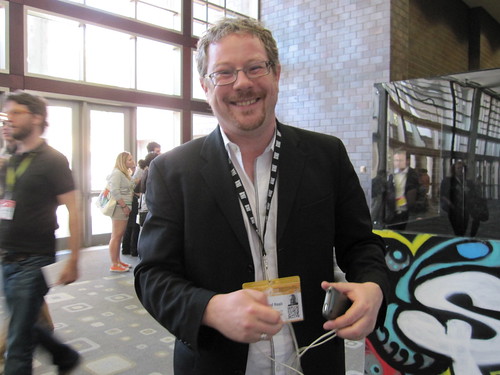 |
| Flickr photo by jessamyn |
To read the full Boston Review interview with Nash click here
Here's more -- "Richard Nash: Publishers Have Lost Their Way, Becoming Printers and Distributors Rather Than Matchmaker." Nash in video interview with Paul Carr of TechCrunch. June 15th, 2011.
Monday, February 6, 2012
What to Read Next?
Wondering what to read next? Perhaps one of these sites can help.
Here's more --
"The Five Best Book Recommendation Services." Lifehacker.com (article doesn't include the two sites mentioned above)
Here's more --
"The Five Best Book Recommendation Services." Lifehacker.com (article doesn't include the two sites mentioned above)
Subscribe to:
Posts (Atom)