Showing posts with label American poets. Show all posts

Monday, March 3, 2014

Seven American Deaths and Disasters (An Interview with Poet Kenneth Goldsmith)

Seven American Deaths
and Disasters
In Seven American Deaths and Disasters, conceptual poet Kenneth Goldsmith offers transcriptions of genuine, as-it-happened radio and television news coverage of seminal events in recent American history: the assassinations of John and Robert Kennedy, the murder of John Lennon, the explosion of the Space Shuttle Challenger, the 9/11 terrorist attacks, and the death of "king of pop" Michael Jackson. Additionally, there is a chilling text taken from an FBI file of an emergency call made by a teacher cowering with her students in the Columbine High School library as prowling gunmen approach the library doors.

Goldsmith is a proponent of "uncreative writing" that retextualizes, reframes, and recycles existing material. He has added nothing to the content of Seven American Deaths and Disasters, which was recently published by New York-based powerHouse Books. His contribution is the concept itself plus careful selection and editing.

"What constitutes the act of writing is rapidly changing in the digital age," Goldsmith explained to The Committee Room. "Skills that we used to consider outside of the scope of writing — word processing, databasing, recycling, appropriation, intentional plagiarism, identity ciphering, and intensive programming, but to name a few — are now the ways we routinely construct literature."

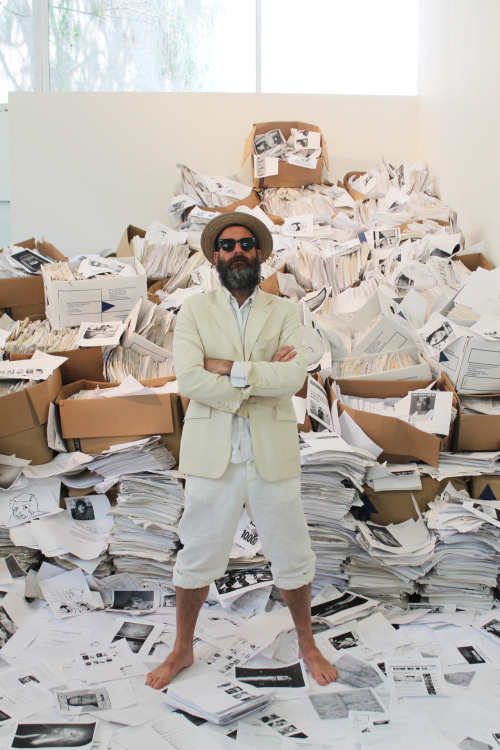
Kenneth Goldsmith
Goldsmith's earlier works include Fidget (2000), a chronicle of every movement of his body over a thirteen hour period, Day (2003), a transcription of a New York Times issue from an ordinary day in 2000, and Printing Out the Internet (2013), a crowdsourced project that invited the public to print out pages of the internet and send them to a Mexico City art gallery to be added to an installation. Ultimately, ten tons of paper was collected.

Tuesday, April 23, 2013

TCR Poem of the Month for April: "Chaplinesque" by Hart Crane

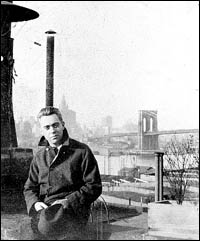
Hart Crane
The Committee Room offers "Chaplinesque" by Hart Crane as TCR Poem of the Month for April. Hart Crane has been called a Modern Romantic who strove to refresh the poet's kinship to the shaman and the seer. In his short career, Crane followed the tradition of Walt Whitman by attempting to capture the range of American experience in his poetry.

Born to a wealthy family in Ohio in 1899, Crane eschewed higher education to pursue what he believed was his destiny to be a poet. He moved to New York City and had his work published in small magazines. His exuberance and good looks, along with his writing, soon established him as an up and coming figure on the literary scene.

Tuesday, March 5, 2013

TCR Poem of the Month: "Poem [Lana Turner has collapsed!]" by Frank O'Hara

Frank O'Hara, c. 1965
(Photo by Richard O. Moore)
The Committee Room begins its TCR Poem of the Month feature with "Poem [Lana Turner has collapsed!]" by Frank O'Hara.

O'Hara was a leading figure in the New York School, a group of poets living in New York in the 1950s and 1960s who valued spontaneity and outward-looking personal expression over polished technique and tortured emotional confessions.

According to O'Hara biographer Brad Gooch in City Poet: The Life and Times of Frank O'Hara, O'Hara was inspired by a tabloid newspaper headline when he wrote "Poem [Lana Turner has collapsed!]" on a snowy evening in February 1962 while riding the Staten Island Ferry. Thirty-five years old and a poet of rising reputation, O'Hara was on his way to a reading he was to give at Staten Island's Wagner College. At the reading, O'Hara shared the newly written poem with an appreciative audience. Scheduled to read for twenty minutes, O'Hara read for an hour, much to the annoyance of his co-presenter, the somewhat older and more eminent Robert Lowell, whose poetry epitomized the confessional style that O'Hara disdained. When Lowell finally began his set he announced he would be reading for only a few minutes and facetiously apologized for not having written a poem on the spot.