Showing posts with label Poems. Show all posts

Tuesday, March 17, 2015

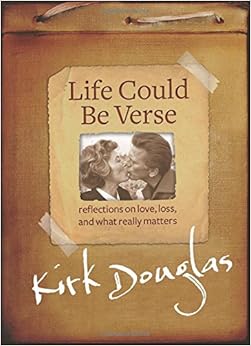
TCR on Films -- "Life Could Be Verse: Reflections on Love, Loss, and What Really Matters" by Kirk Douglas

In Life Could Be Verse, a brief and often affecting volume, actor Kirk Douglas, who recently turned ninety-eight years old, shares poems he has written over the course of his long life and recounts the experiences that inspired the verses.

Kirk wrote his first poem -- about a sailing ship, though he had never seen the ocean -- for an English class assignment as a high school student in upstate New York back when he was still Issur Danielovitch, the child of impoverished Russian Jewish immigrants. He discovered that versifying helped him better understand his thoughts. "Throughout my life I have written poems that express my true feelings," Kirk explains in the book's acknowledgments.

The poems are simple but perceptive reflections set in singsong rhyme and might be called wise doggerel. Here are the opening lines from "Luck" -- They call it 'luck'/It can't be taught/It can't be borrowed/It can't be bought'. Kirk's movie stardom, though discussed in the book, takes a back seat to his roles of son, husband, father, and grandfather.

.

Thursday, December 12, 2013

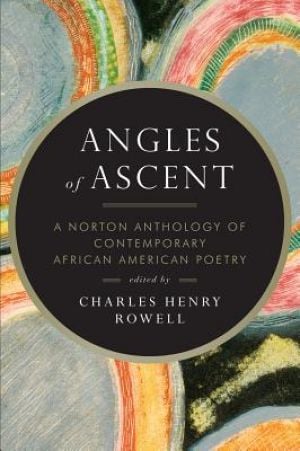
TCR Recommends -- "Angles of Ascent: A Norton Anthology of Contemporary African American Poetry" (An Interview with Editor Charles Henry Rowell)

The Committee Room recently spoke with Charles Henry Rowell, editor of Angles of Ascent: A Norton Anthology of Contemporary African American Poetry. Critics have called Angles of Ascent, which was published by W.W. Norton earlier this year, "monumental...an enormous and solid bequest to readers of American poetry" and a "a must-have powerhouse poetry anthology."

The anthology focuses on poems created in the last thirty years. "I wanted to give readers a cross-section of what I consider as the representative literary poetry that African Americans are now producing," Rowell explained to The Committee Room.

In order to provide a clearer understanding of what makes contemporary African American poetry different from what went before it, Angles of Ascent offers a sampling of earlier works by poets Rowell calls the "Precusors", including Gwendolyn Brooks, Amiri Baraka, Audre Lorde, and Robert Hayden.

Poet Amiri Baraka, a "Precursor."
(photo by Newark Mosaic)
The title of the anthology comes from a line in Hayden's poem "For a Young Artist." Rowell told TCR that he hopes "that new and emerging writers will read the contemporary poets—poets who began the main of their writing and publishing since the 1980s—in Angles of Ascent as exempla of what is necessary to do with literary traditions: with a critical eye and ear to pick and choose what to use or discard...Whatever you, as artist, choose, you, like the contemporary poets in the anthology, should try to extend, refine, or remake it, in your own voice, or reshape it in terms of your own vision as a necessary voice in your time."

Tuesday, April 23, 2013

TCR Poem of the Month for April: "Chaplinesque" by Hart Crane

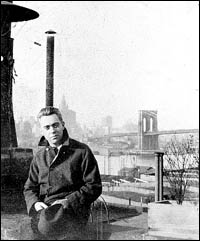
Hart Crane
The Committee Room offers "Chaplinesque" by Hart Crane as TCR Poem of the Month for April. Hart Crane has been called a Modern Romantic who strove to refresh the poet's kinship to the shaman and the seer. In his short career, Crane followed the tradition of Walt Whitman by attempting to capture the range of American experience in his poetry.

Born to a wealthy family in Ohio in 1899, Crane eschewed higher education to pursue what he believed was his destiny to be a poet. He moved to New York City and had his work published in small magazines. His exuberance and good looks, along with his writing, soon established him as an up and coming figure on the literary scene.

Tuesday, March 5, 2013

TCR Poem of the Month: "Poem [Lana Turner has collapsed!]" by Frank O'Hara

Frank O'Hara, c. 1965
(Photo by Richard O. Moore)
The Committee Room begins its TCR Poem of the Month feature with "Poem [Lana Turner has collapsed!]" by Frank O'Hara.

O'Hara was a leading figure in the New York School, a group of poets living in New York in the 1950s and 1960s who valued spontaneity and outward-looking personal expression over polished technique and tortured emotional confessions.

According to O'Hara biographer Brad Gooch in City Poet: The Life and Times of Frank O'Hara, O'Hara was inspired by a tabloid newspaper headline when he wrote "Poem [Lana Turner has collapsed!]" on a snowy evening in February 1962 while riding the Staten Island Ferry. Thirty-five years old and a poet of rising reputation, O'Hara was on his way to a reading he was to give at Staten Island's Wagner College. At the reading, O'Hara shared the newly written poem with an appreciative audience. Scheduled to read for twenty minutes, O'Hara read for an hour, much to the annoyance of his co-presenter, the somewhat older and more eminent Robert Lowell, whose poetry epitomized the confessional style that O'Hara disdained. When Lowell finally began his set he announced he would be reading for only a few minutes and facetiously apologized for not having written a poem on the spot.