Thursday, September 26, 2013

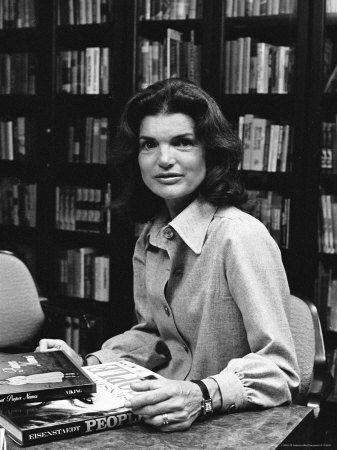
Jacqueline Kennedy Onassis' Career in Publishing

Jackie at work.
As the fiftieth anniversary of the assassination of President John F. Kennedy approaches The Committee Room pauses for a look at Jacqueline Kennedy Onassis' career in publishing.

The former First Lady spent nearly twenty years as an editor, a period longer than that of her celebrated marriages to JFK and Aristotle Onassis combined. First at Viking, then at Doubleday, Jackie helped shepherd to publication nearly one hundred books, both fiction and non-fiction.

The death of Greek shipping magnate Onassis in the spring of 1975
left Jackie, at age forty-five, a widow for the second time.
Her children were teenagers requiring less of her attention. The most famous woman in the world found herself at something of a loose end.

Tuesday, September 17, 2013

TCR Story of the Month for September: "Senator Max Baucus Leaves Five Tips" by Kelly Ramsey

Author Kelly Ramsey
The Committee Room is proud to present "Senator Max Baucus Leaves Five Tips" by Kelly Ramsey as TCR Story of the Month for September.

A highly original work of fiction using real life characters and skillfully manipulated visuals, "Senator Max Baucus Leaves Five Tips" grabs the attention with its brief but incisive look at politics, power, and personal relationships.

Kelly Ramsey's prose has appeared or is forthcoming in American Short Fiction, Orion, and The Material. This October she will be a fellow at the MacDowell Colony.

Tuesday, September 10, 2013

TCR Literary Journals Series: A Brief Interview with Linda Swanson-Davies of Glimmer Train

Issue 88, Fall 2013
The Committee Room recently talked with Linda Swanson-Davies, co-editor and co-founder of Glimmer Train, a leading American literary magazine. An independent publication based in Portland, Oregon, Glimmer Train was established in 1990 by Swanson-Davies and her sister Susan Burmeister-Brown. Neither woman had an academic background in literature. They were simply voracious readers who wanted to bring good writing to a larger audience.

The journal's title comes from the sisters having had no plans to start a literary journal but could in retrospect see that glimmers of the idea had gone through their minds. Now that the idea had fully emerged they were going forward with it like a locomotive speeding down the rails.  

Glimmer Train is published three times a year in carefully put together print issues, including a Spring/Summer double issue. Swanson-Davies and Burmeister-Brown strongly believe that a handsome physical publication reflects the enduring quality of its contents. They are also committed to paying the writers whose work appears in Glimmer Train. Over $50,000, funded by contest fees and subscriptions, goes to writers each year.

Tuesday, September 3, 2013

The 200 Best Novels in English Since 1950

What were the best English language novels written in the second half of the twentieth century? Writer Colm Toibin and editor/publisher Carmen Callil tackle this question in The Modern Library: A Brief Guide to the 200 Best Novels in English Since 1950.

"Enthusiasm is the driving force of this book. Its purpose is to celebrate the writers we have loved best, and to proselytize on behalf of their novels," Toibin and Callil write in the introduction.

Toibin and Callil delineate three types of novels written since 1950 -- "massively ambitious and complex" works such as William Gaddis' The Recognitions (1955) and Angela Carter's Wise Children (1991) that "take their bearings" from the early twentieth century Modernist giants James Joyce and Virginia Woolf and leave characters, dialogue, and plot "open to question;" traditional style novels, such as Anita Brookner's Friends and Family (1985) and Patrick Hamilton's The West Pier (1951), that follow a "system in which things are slowly revealed and objects in the landscape are described in some detail;" and a modernist/traditional combination, the most common style in the later twentieth century, that takes in lessons from Joyce and Woolf about language, form, voice, and tone without abandoning completely traditional narrative methods.

Tuesday, August 13, 2013

The Books That Mattered: "All the King's Men" and more

The Committee Room pauses to reflect that, in most cases, we only dimly recall books years after our reading of them is done. Some books get completely forgotten. Lasting bonds are forged with only a small percentage of the books that come into our lives. These might be called the books that mattered.

In The Books That Mattered: A Reader's Memoir, writer and editor Frye Gaillard considers books -- both fiction and non-fiction -- that have mattered most to him. "I had always wanted to write a book about books, those that had brought me the greatest delight through the years," Gaillard writes in the book's prologue."I wanted to offer a reader's tribute, but more than that, a kind of reader's memoir, a recounting of exactly why and when these volumes had mattered "

Gaillard tried to keep the list to twenty-five titles but somehow it grew to over thirty. His selections are not necessarily what he considers to be the best books ever written "but simply those that have mattered most to me."

Monday, July 22, 2013

TCR Story of the Month for July: "On a Foggy Night in Paris, A Bullet Shot Randomly Into the Air is Bound to be Intercepted by Human Flesh" by Josepha Gutelius

Josepha Gutelius
The Committee Room is pleased to offer "On a Foggy Night in Paris, A Bullet Shot Randomly into the Air is Bound to Be Intercepted by Human Flesh" by Josepha Gutelius as TCR Story of the Month for July.

"On a Foggy Night in Paris, a Bullet Shot Randomly into the Air is Bound to Be Intercepted by Human Flesh," a witty and carefully observed tale of a young American bureaucrat in the beautiful but impenetrable City of Light, was published in Northwind (Spring 2013).

Josepha Gutelius writes plays, short stories, and poetry. Her story “Penny” was chosen for the anthology Best New Writing 2013. She is a Pushcart Prize nominee and an Eric Hoffer Award finalist.

Friday, July 12, 2013

TCR Interviews: Noreen Tomassi, Executive Director of The Center for Fiction (New York City)

The Center for Fiction
(photo from Janet Reid, Literary Agent blog)
The Committee Room takes a look at The Center for Fiction, the only organization in the United States dedicated to the art of fiction.

Located in midtown Manhattan, the Center for Fiction, which opened in 2005, offers a wide variety of resources including workshops, author readings, and reading groups. It also rents desk space to writers in need of a quiet place to get their work done, runs a fiction focused bookstore on its ground floor, publishes a literary magazine, The Literarianand even offers something called "bibliotherapy" a service where readers are provided with a carefully selected, individually tailored list of fictional works to help see them though life's problems.  

"The Center is clearly growing, cultivating an audience for its varied and various programs and, in my view, is indeed succeeding in creating a nexus where writers and readers can share their passion for literature," wrote H.J. Schreiber in Nybeat -- Culture on a Shoestring.