Wednesday, May 15, 2013

Twelve Great American Novels (and The Great Gatsby, too)

The Far Side of Paradise
(first edition, 1951)
The Committee Room marks the release of the latest film version of The Great Gatsby by taking a look at The Far Side of Paradise, Arthur Mizener's classic biography of F. Scott Fitzgerald that played an important role in establishing Fitzgerald's reputation as a major American writer.

For much of the 1930s and 1940s, Fitzgerald was widely viewed as a literary curiosity noteworthy only for his vivid depictions of the Roaring Twenties. When Fitzgerald died in December 1940, a New York Times obituary carried the headline "Brilliant novelist of the Twenties; inactive recently" and noted that "the promise of his brilliant career was never fulfilled."

Wednesday, May 1, 2013

TCR Story of the Month for May: "Homunculus" by Adam McOmber


Adam McOmber
The Committee Room is pleased to present "Homunculus" by Adam McOmber as TCR Story of the Month for May. A meticulously rendered and highly unusual story, "Homunculus" deals with matters of science, history, and extreme personal creativity.  

McOmber is the author of the novel The White Forest (Touchstone, 2012) and the short story collection This New & Poisonous Air (BOA Editions, 2011). His work has appeared recently in Conjunctions and Fairy Tale Review. He is the Associate Editor of Hotel Amerika at Columbia College Chicago
where he teaches literature and creative writing.

Tuesday, April 23, 2013

TCR Poem of the Month for April: "Chaplinesque" by Hart Crane

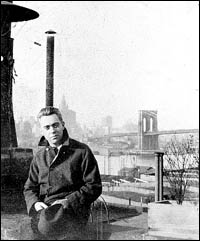
Hart Crane
The Committee Room offers "Chaplinesque" by Hart Crane as TCR Poem of the Month for April. Hart Crane has been called a Modern Romantic who strove to refresh the poet's kinship to the shaman and the seer. In his short career, Crane followed the tradition of Walt Whitman by attempting to capture the range of American experience in his poetry.

Born to a wealthy family in Ohio in 1899, Crane eschewed higher education to pursue what he believed was his destiny to be a poet. He moved to New York City and had his work published in small magazines. His exuberance and good looks, along with his writing, soon established him as an up and coming figure on the literary scene.

Wednesday, April 10, 2013

TCR Spotlight on Theater: Most Produced Plays in America

Walnut Street Theatre,
Philadelphia, 2013
The Committee Room takes a look at what plays are being produced at American theaters.

According to Theatre Communications Group, which includes nearly five-hundred professional, not-for-profit theaters, large and small, across the United States, the most produced play of the 2012-2013 season is Good People by David Lindsay-Abaire.

A drama peppered with biting wit, Good People is the story of an unemployed single mother from blue collar South Boston reconnecting with a high school boyfriend in the hope of finding a job. The boyfriend got out of their gritty neighborhood and is now a doctor living in an upscale suburb.

Monday, March 25, 2013

Reading and Writing of U.S. Presidents: Richard Nixon

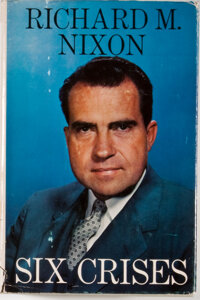
Six Crises, first edition, 1962
The Committee Room returns by popular demand to the subject of the reading and writing of U.S. Presidents. In an earlier article we discussed George Washington, John Adams, Ulysses Grant, and John F. Kennedy. Now, in observance of the centenary of his birth and the fortieth anniversary of the start of his unfinished second term we take a look at the literary record of one of the most controversial and most prolific of the American Presidents, Richard Milhous Nixon.

Richard Nixon was born on a citrus ranch in Yorba Linda, California in 1913 to a devoutly Quaker family. As a small child he was taught to read by his mother. Already knowing how to read when he entered school enabled him to skip from the first to the third grade. In his book RN: The Memoirs of Richard Nixon Nixon writes of his early life in Yorba Linda -- "After homework and chores, I often sat by the fireplace or at the kitchen table immersed in a book or magazine. We took the Los Angeles Times, the Saturday Evening Post, and the Ladies' Home Journal. Aunt Olive, my mother's youngest sister, and her husband, Oscar Marshburn, lived in nearby Whittier and subscribed to the National Geographic. Nearly every time I visited them I borrowed a copy. It was my favorite magazine."

Tuesday, March 19, 2013

TCR Story of the Month for March: "Mentos" by Holly Thompson

Holly Thompson
The Committee Room is very happy to offer "Mentos" by Holly Thompson as TCR Story of the Month for March.

"Mentos" is a superbly crafted work of flash fiction. Employing masterful focus and a light touch, Thompson packs this very short story with insight into addiction, life in a global culture, and family relationships.

Holly Thompson is the author of two young adult novels in verse: Orchards, winner of the APALA Asian/Pacific American Award for Literature, and The Language Inside, both published by Delacorte/Random House. She is also author of the novel Ash and the picture book The Wakame Gatherers. Her stories and essays have been published in magazines in Japan and the United States. She co-writes the column “Double Take” in ANA Wingspan magazine.

Tuesday, March 5, 2013

TCR Poem of the Month: "Poem [Lana Turner has collapsed!]" by Frank O'Hara

Frank O'Hara, c. 1965
(Photo by Richard O. Moore)
The Committee Room begins its TCR Poem of the Month feature with "Poem [Lana Turner has collapsed!]" by Frank O'Hara.

O'Hara was a leading figure in the New York School, a group of poets living in New York in the 1950s and 1960s who valued spontaneity and outward-looking personal expression over polished technique and tortured emotional confessions.

According to O'Hara biographer Brad Gooch in City Poet: The Life and Times of Frank O'Hara, O'Hara was inspired by a tabloid newspaper headline when he wrote "Poem [Lana Turner has collapsed!]" on a snowy evening in February 1962 while riding the Staten Island Ferry. Thirty-five years old and a poet of rising reputation, O'Hara was on his way to a reading he was to give at Staten Island's Wagner College. At the reading, O'Hara shared the newly written poem with an appreciative audience. Scheduled to read for twenty minutes, O'Hara read for an hour, much to the annoyance of his co-presenter, the somewhat older and more eminent Robert Lowell, whose poetry epitomized the confessional style that O'Hara disdained. When Lowell finally began his set he announced he would be reading for only a few minutes and facetiously apologized for not having written a poem on the spot.